AI for photonics & integrated photonic design
Junho Park
Second-year Ph.D. student NSF GRFP Fellow
I am a second-year Ph.D. student in Electrical & Computer Engineering at the University of Michigan, advised by Prof. Di Liang in the Large Scale Integrated Photonics Lab, and an NSF Graduate Research Fellow.
My research focuses on AI for photonics, including agentic photonic integrated circuit (PIC) design and inverse design for integrated photonics. I combine generative priors, physics-based optimization, and interpretable design tools to make the path from device specifications to fabrication-aware layouts more efficient and automated.
Previously, I studied Electrical Engineering & Computer Science and Materials Science & Engineering at UC Berkeley, graduating with EECS Honors. I have also worked at Apple, Amazon Web Services, and STMicroelectronics.
Ann Arbor, Michigan
News
- Jul 2026
Two papers accepted for oral presentations at IEEE IPC 2026! I’ll be in Denver, November 8–12, to share our work on generative-prior-guided inverse design and solver-native adjoint attribution. Conference details.
- Jul 2026
Our paper, Interpretable geometry sensitivity for inverse design of integrated photonics, was selected as an Editor’s Pick in APL Engineering Physics. Read the paper.
- May 2026
At CLEO 2026 in Charlotte, NC, we presented two papers: interpretable inverse design via pixel-level sensitivity and etch-free III-nitride photonics via bottom-up selective-area growth.
- Apr 2026
I received the NSF Graduate Research Fellowship, supporting my research in AI for integrated photonics.
Research
Selected publications
-
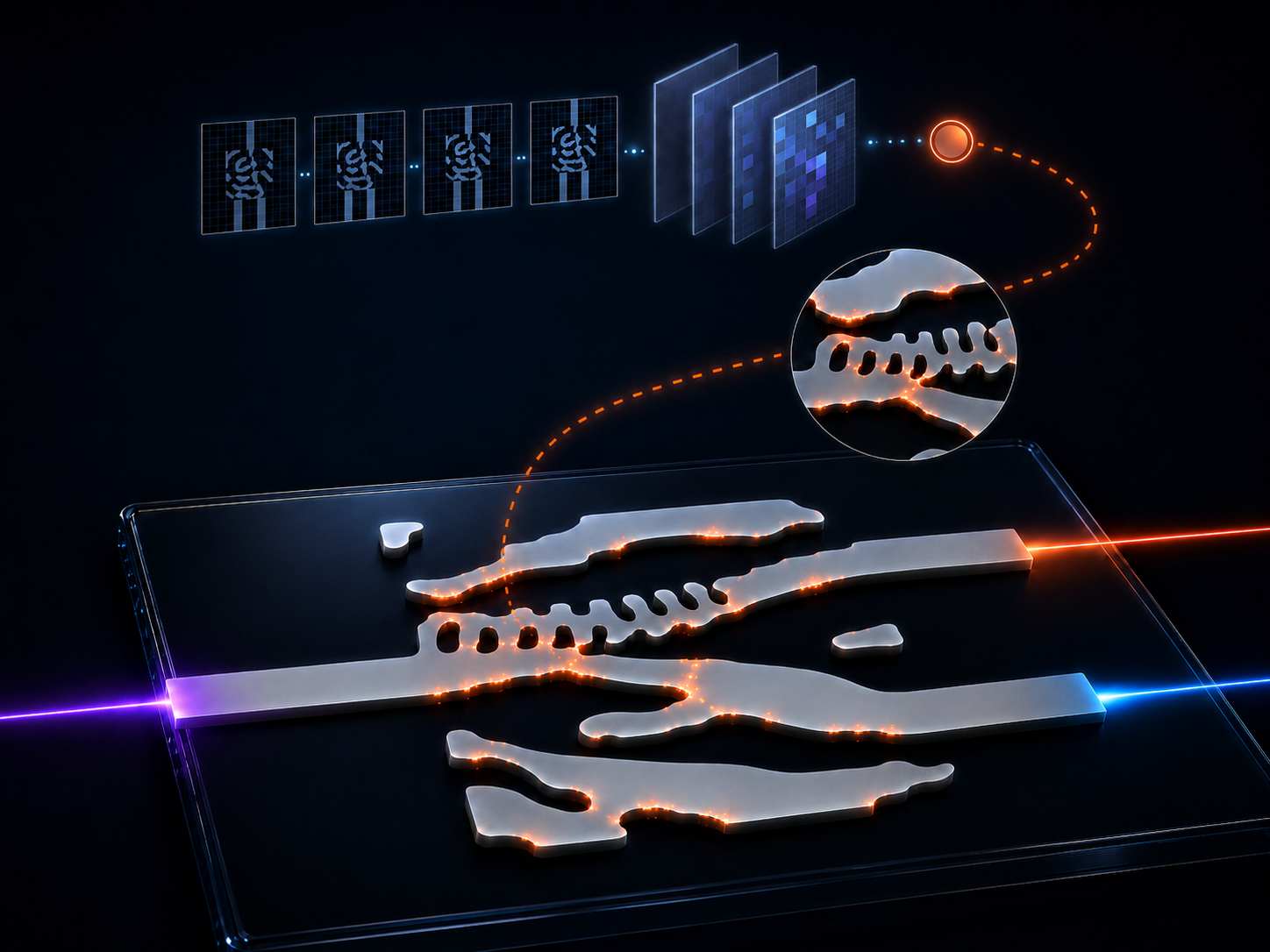
Interpretable geometry sensitivity for inverse design of integrated photonics
APL Engineering Physics, 2026Integrated Gradients maps pixel-level geometry sensitivity in inverse-designed photonic devices, with experiments confirming that identified hotspots are more vulnerable to fabrication perturbations.
-
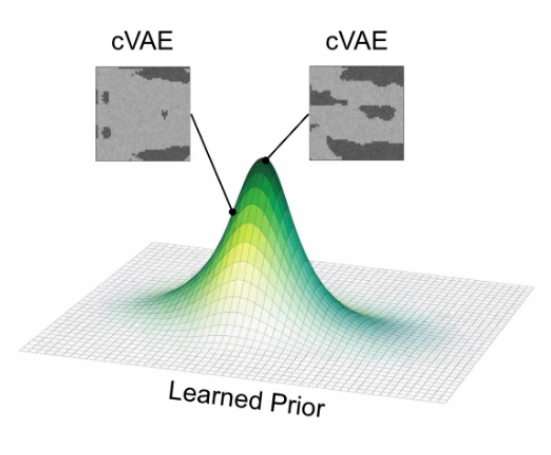
A Generative Prior-Guided Faster Inverse Design Framework for High-Quality Integrated Photonics
In IEEE Photonics Conference (IPC), 2026Generative priors improve performance, manufacturability, and optimization speed in fabricated silicon power splitters.
-
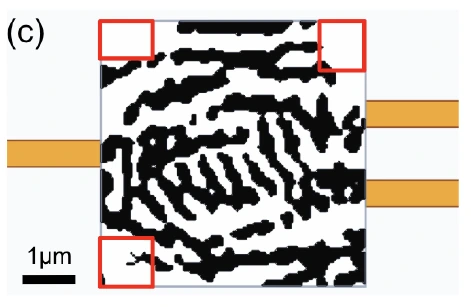
Solver-Native Adjoint Attribution for Trimming Inverse-Designed Photonic Layouts
In IEEE Photonics Conference (IPC), 2026Solver-native attribution identifies low-impact silicon for trimming while preserving simulated optical performance.
-
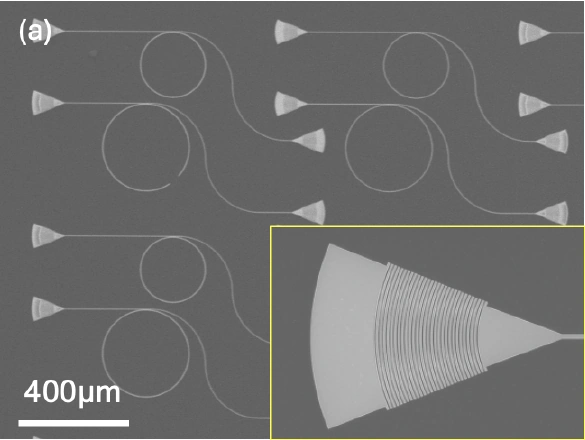
Etch-Free Integrated III-Nitride Photonics via Bottom-Up Selective-Area Growth
In Conference on Lasers and Electro-Optics (CLEO), 2026Bottom-up selective-area growth creates GaN waveguides, microring resonators, and grating couplers with crystallographic sidewalls, avoiding plasma damage from conventional device etching.
-
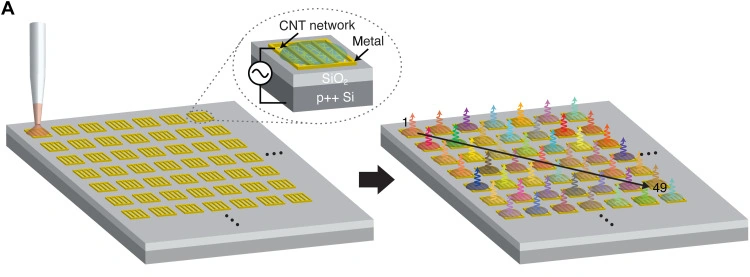
Cropped from Fig. 1A, Wang et al., Science Advances (2023). CC BY-NC 4.0.
Highly multicolored light-emitting arrays for compressive spectroscopy
Science Advances, 2023A chip with 49 individually addressable emission colors enables compact spectroscopy and spectral imaging through compressive reconstruction without diffractive optics.

* Equal contribution.